
 First Trump threatened to destroy all of Iran civilization. He was forced to realize that he’d painted himself into a corner, and he was desperate to escape, so he signed some sort of “peace deal” with Iran which wasn’t even dead on arrival; it was dead before it arrived! Nobody knows how the war will develop from here, but it’s easy to see why the attention of millions will be focused on that rather than the struggle of the Kurdish people in Iraq, or really anywhere else in Kurdistan. And yet, the two are intimately connected; it’s impossible to fully understand how the world got here without understanding the role of the Kurdish struggle throughout Kurdistan. That’s what gives the topic added importance if it weren’t important enough in its own right. We start from that point of view.
Rise of Iraqi Kurdish parties
Today, the Kurds in Iraq compose the only part of Kurdistan with autonomous rule. That region is in northeast Iraq. The northern part of that region is ruled by the

Talabani and Barzani
Kurdish Democratic Party (KDP) led by Masoud Barzani. The southern part of that autonomous region is ruled by the Patriotic Union of Kurdistan (PUK) led by Befal Talabani. These are the two main Kurdish parties of Iraq. The rise of these two parties, their base, their intrigues against each other, their relations with both the Baghdad government as well as other governments is all incredibly complex. Keeping track of it all is like keeping track of the shifting sands in the desert.
The main reason for this complexity and intrigue is the fact that neither party bases itself on the working class, which is the only class that can play a role that is independent of both the Iraqi capitalist class as well as the intrigues of global capitalism – imperialism, in other words. As a result, both parties have to continuously maneuver with and between greater forces, now aligning themselves with one capitalist force now with another.

The KDP
KDP
The earliest Iraqi Kurdish party was the Kurdistan Democratic Party (KDP), founded in 1946 by the cleric Qazi Muhammed. One of the real powers in the KDP, however, was Mustafa Barzani the hereditary feudal ruler of the Barzani tribe. Barzani had been a power in the short-lived Kurdish Republic of Mahabad, which was declared by the Soviet Union in 1941. At that time, the Soviet bureaucracy was feuding with the Iranian and Iraqi regimes and saw the establishment of Mahabad as a means of weakening them. When the Soviet bureaucracy changed its approach, it dropped support for Mahabad, which collapsed in short order and Barzani had to flee to the Soviet Union. There he remained in exile while the KDP was founded.
His return was opposed by Rizgari, the Kurdish section of the Iraqi communist party. Barzani was able to split Rizgari and gain support from other Kurdish leftists. The new KDP of Iraq held his first Congress in Baghdad in 1946. Barzani was elected as president in exile. The party was broadly “left“ but was not specific about any social or economic content for fear of alienating the highly conservative, tribal, chief, and landlords who had agreed to support it.
In 1947 Ibrahim Ahmad, who was connected to the Iranian KDP joined the Iraqi KDP. Ahmad’s base was petit bourgeois left intellectuals. By 1951 most of the Iraqi Kurdish leftist nationalists had joined the KDP. Subsequently Ahmad was elected as a secretary general of the KDP.
Throughout the late 1940s and early 1950s the KDP and the Kurdish members of the Iraqi communist party steadily increased their working relationship. In many cases, they ran joint candidates for office. The Iraqi communist party campaign directly against the feudal tribal leaders, known as “aghas”. Because of their campaign against the aghas, the Iraqi Communist Party won the support of the workers in cities like Erbil, Duhok, and Sulaymaniyah. Behind the scenes, however, the KDP reassured the aghas that they – the KDP – could control the Iraqi Communist Party.
In 1958 the Iraqi monarchy was overthrown by Brigadier General Abdul Karim Kassem. He allowed Barzani to return from exile in the Soviet Unions. However, Kassem then turned around and bombed Barzan Kurdish villages, leading Barzani to join the KDP and lead a revolt which weakened Kassem’s forces. In 1964. Abdul Salim Arif, Iraqi head of state, reached an agreement with Barzani regarding Kurdish rights. Wikipedia writes that “Mulla Mustafa [Barzani] rallied the conservatives and tribal leaders to his side.” That agreement did not include anything about Kurdish autonomy and it was opposed by the left intellectuals Jalal Talabani and Ibrahim Ahmad who led a faction within the KDP. Barzani had members of the Talabani-Ahmad faction arrested upon their arrival at the convention. He also engineered the expulsion of Talabani and Ahmad from the KDP. Subsequently, Barzani sent an armed force of some 4,000 followers to drive Talabani into exile in Iran and Ahmad into exile in Britain.

The PUK
PUK
In 1974-5 there was a Kurdish revolt in Iraq which was bloodily suppressed. That Kurdish defeat led Talabani to form the Patriotic Union of Kurdistan (PUK). This party included leaders of the communist Komala as well as the Kurdistan Socialist Movement (KSM). The real class base of the PUK, however, was leftist intellectuals. According to Wikipedia, “the PUK served as an umbrella organization unifying various trends within the Kurdish political movement in Iraq.”
According to Wikipedia, throughout this period, Barzani maneuvered between and was used by the Russian KGB, the CIA, Mossad, MI6 and the Iranian SAVAK. This shows, once again, how even in that early period a purely nationalist Kurdish struggle could not free itself from the influence of one imperialist power or another.
In 1979 Saddam Hussein took power and in 1980 he went to war with Iran. That war lasted eight years, during which both the KDP and the PUK supported Iran, with devastating consequences. From 1987-9, Hussein conducted what was called the Anfil campaign. This was an ethnic cleansing operation on the scale of what the Zionists did during the Israeli “war of independence”. According to Human Rights Watch, the Anfil campaign included:
- Mass summary excutions and disappearances of tens of thousands

Kurdish genocide: Iraq’s Anfil campaign
on non-combatants, including women and children and sometimes entire village populations;
- Widespread use of chemical weapons including mustard gas and sarin;
- Wholesale destruction of entire villages and civilian objects like schools, mosques, wells;
- Widespread army looting of civilian property and farm animals;
- Arbitrary arrest and imprisonment of all villagers, including children, captured in “prohibited areas”;
- forced displacement – ethnic cleansing – of thousands of villagers;
- Destruction of the rural Kurdish economy and infrastructure.
Ebsco.com summarizes this entire history as follows: “The history of Iraq’s treatment of the Kurds features violence joined to broken promises. This applies to one Iraqi regime after another, with the exception of the [2023] current fledgling democratic government, whose legacy is yet to be fully known. The Hashemite monarchy of 1921 to 1958, a creation and perpetual satellite of the British, repressed the Kurds, causing revolts. The Republic of Iraq easily outdistanced the monarchy in viciousness….”
The inability of the Hussein government to defeat Iran led to widespread perception of weakness of that government. That, in itself, led to a renewed struggle – an uprising – of the masses of the Kurdish people themselves. Barzani commented: “The uprising came from the people themselves. We didn’t expect it.” In other words, their “military” approach to the struggle was not based on the people; it was based on a relatively small group of guerrillas.
In 1991, the US went to war against the Hussein government. Bush encouraged the Kurds to rise up against Hussein and then more or less stood aside. However, the US did establish a no-fly zone over Iraqi Kurdistan, which enabled the Kurdish forces to establish a degree of autonomy. Then in 2003 the US invaded Iraq and brought down the government while it also created chaos and destruction throughout society. This led to two results among others:
First, the US-dictated 2005 constitution formally established a Kurdish autonomous zone in northeast Iraq. They created the Kurdish Regional Government (KRG). On the other hand, the war crimes committed by US forces combined with the general destruction of Iraqi society to open the door to the rise of ISIL in 2011, later to be renamed ISIS. Their armies rapidly advanced in Iraq and in 2017 they seized Iraq’s second largest city, Mosul. Just as the US relied on the Kurdish YPG to fight ISIS in Syria, so they relied on the Peshmerga in Iraq. The Peshmerga expanded the KRG to include the oil-rich area of Kirkuk, which the Baghdad government had to accept because the only other option was to allow ISIS control. The KRG control over Kirkuk contains some of the same potential tensions as we described in Kurdish control over part of Syria because the Kurdish population of that region is only about 40-50%. As for other groups, the map shows that Kirkuk is claimed and controlled by the KRG, but that claim is disputed by Baghdad. This dispute is certain to result in armed conflict at some point in the future.
A future conflict is made more likely by the situation within the KRG-controlled  area. In the first place, as the map shows, the KRG itself is really divided in two, with the KDP ruling in the north and the PUK in the south. Whatever programmatic conflicts between these two parties that may have existed in the past, such conflicts have largely receded. In their place remain simple power maneuvering. The PUK is closer to Turkey’s PKK (the original Ocalan party) and the PKK affiliate in Iran, PJAK. But as we have seen, such alliances are strictly a matter of tactical convenience and can shift over time. In fact, the BBC reports that “Turkish forces have established military bases deep into Kurdish territory… one that has been permitted, and even facilitated by local Kurdish political parties (PDK – aka KDP – and PUK) and ignored by the central Iraqi government…. Turkey has effectively created a parallel state structure in parts of Kuhok and other regions” of the KRG in Iraq. The report says both the KDP and the PUK are complicit.

Map of KRG area showing ethnic density.
The other problem is similar to what the PYD faced in Syria as discussed in the part on Iran in this series: Not everybody in the KRG controlled region is Kurdish. In fact, as the map shows, some regions are majority Arab. If the KRG rule favored the working class, that wouldn’t be much of a problem, but it does not. So, there is bound to be resentment in the Arab majority areas based on nationalism.
The Kurdish Regional Government (KRG) rule has resolved nothing for the people under their control. There are multiple reports of rampant corruption. For example, the Organized Crime and Reporting Project outlines massive self enrichment of the Barzani family, including their purchases of mansions and business properties in Washington DC, Florida, Texas and California; a Barzani-owned company named Golden Eagle used by the Barzani controlled KRG as a go-between for that government and foreign investors, and so on. Barzaniwatch reports similar corruption, including the alleged extortion of $5 million from an Iraqi business in Erbil. A civil complaint was filed against the Barzanis in a US court. There, they are accused of “extrajudicial killings, genocide, hostage taking and kidnapping, enforced disappearances, inhuman treatment, torture, rape, crimes against humanity, and multitudinous other unlawful and material acts”. The Barzani family is described as being “a mafia outfit dedicated to lining their own pockets.”
But it is not just the KDP. Barzaniwatch also reports that the PUK is also involved in oil smuggling. In general, the PUK-controlled region of the KRG is considered to be equally corrupt. Ragad Azadi Organization describes the corruption of both the Barzani (KDP) and the Talabani (PUK) families: “Independent reports estimate that the Region produces over 150 million barrels of oil annually, generating tens of billions in revenue. Yet the crucial question remains: Where has this wealth gone?
“Despite vast income, the KRG has failed to invest adequately in healthcare, education, infrastructure, or welfare. Instead, these revenues have allegedly been funnelled into private business empires, international real estate portfolios, and luxury lifestyles benefiting only the elite.
“The people of Kurdistan have endured decades of suffering due to systemic corruption, poor governance, and blatant resource theft. Public services are crumbling, salaries are delayed, and families are pushed deeper into poverty—while private jets, luxury villas, and foreign companies blossom under the names of political heirs.” (As an aside: will any investment money in Syria be treated very differently?)
Despite these problems, the situation for workers in Iraqi Kurdistan was markedly better than in the rest of Iraq after the US invasion. This is a report from a former British Labour MP, Harry Barnes, who traveled to Iraq in 2005. He reports on the history of the Iraqi labor movement, which we will discuss later, but he also reports that during his visit there the situation for labor organizers in Iraqi Kurdistan was far better than in the rest of Iraq, where terrorist attacks on worker activists was commonplace. In Iraqi Kurdistan, armed Kurdish groups – probably the Peshmerga – protected not only Barnes and his fellow visitors but Iraqi workers in general.
This situation shows the potential in all of Iraq in the decades before the invasion. (Note: the following information is derived from Barnes’ article as well as Wikipedia.) The Iraqi working class started organizing unions in the 1920s. In 1935, the British, who ruled Iraq at that time, banned unions in Iraq. Nevertheless, workers continued to organize. The British were more or less “swept aside” following WW II and in 1949 a huge march of a half million workers was organized for May Day. There was a series of coups and counter coups in the 1960s and ‘70s which culminated in Saddam Hussein taking power in 1979. During all these years, repression of the Iraqi workers increased. In fact, even in 1977, one prominent union leader, Hadi Saleh, had to flee the country. Once Hussein came to power, the situation for the unions got even worse.
Then, following his removal, union leaders started to return from exile and others emerged from underground. A renewal of the labor movement got underway and in 2004 the Iraqi Federation of Trade Unions was founded. One of the major barriers union organizers faced was a terror campaign waged by Mukhabarat remnants of
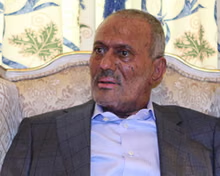
“Hadi” Saleh, hero of the Iraqi labor movement. Murdered by the Mukhabarat
Hussein’s regime. Leader after leader was killed. For instance, Wikipedia reports: “On November 3, 2004, four railroad workers were killed and mutilated; on December 25, two train engineers were kidnapped and five additional workers were beaten. On January 4, terrorists believed to be part of the disbanded Mukhabarat broke into the house of IFTU international secretary Hadi Saleh and brutally tortured and murdered him.” According to Barnes, when Saleh was murdered the terrorists also seized his organizing documents which included names of his fellow organizers. The Mukhabarat terrorists used this information to find and murder some 2,000 of Saleh’s comrades.

Iraqi women workers organize.
This did not stop workers from organizing. The NewArab reports that “A series of demonstrations, marches, sit-ins and civil disobedience took place in Iraq from 2019 until 2021. It started on 1 October 2019, a date which was set by civil activists on social media, spreading mainly over the central and southern provinces of Iraq, to protest corruption, high unemployment, political sectarianism, inefficient public services and foreign interventionism. Protests spread quickly, coordinated over social media, to other provinces in Iraq. As the intensity of the demonstrations peaked in late October, protesters’ anger focused not only on the desire for a complete overhaul of the Iraqi government but also on driving out Iranian influence, including Iranian-aligned Shia militias.” The NewArab also reports on 2025 MayDay activity in Iraq.

Iraqi workers on the march, May Day 2015
This rich history of workers struggle could have provided a golden opportunity to link workers struggles with the struggle of the Kurdish people. For example, following the fall of the Hussein regime, it was the Peshmerga that was able to counter the remnants of the Hussein regime in Iraqi Kurdistan. That armed self defense was desperately needed in the rest of Iraq and the Peshmerga could have helped arm and train it. Not only that but linked as the Kurdish parties were to the “aghas”, it seems unlikely that these parties would have even been friendly to worker organizing in the regions they controlled.
The result has been a division between the Kurdish and Arab workers from which they both suffer. Nor will Iraqi Kurds escape the criminal war being waged by the United States and Israel. In March, CNN (among others) reported that “The Trump administration has been in active discussions with Iranian opposition groups and Kurdish leaders in Iraq about providing them with military support, the sources said.” They further reported: “Also on Tuesday, President Donald Trump spoke with the president of the Democratic Party of Iranian Kurdistan (KDPI), Mustafa Hijri, according to a senior Iranian Kurdish official. KDPI was one of the groups targeted by the IRGC.
Any attempt to arm Iranian Kurdish groups would need support from the Iraqi Kurds to let the weapons transit and use Iraqi Kurdistan as launching ground. ‘[It’s] very dangerous, but what can we do? We cannot stand against America,’ said the senior Kurdistan Regional Government official. ‘We are very frightened.’”
Trump has publicly retreated from his thought that the Iranian Kurdish parties could lead the overthrow of the Iranian regime. That, however, has not stopped the Iranian regime from attacking the Kurds. On April 3, the NewArab Weekly reported on the Iran regime attacking both Iranian and Iraqi Kurdish groups in Iraq. The NewArab also said there are expectations for Iranian Kurdish groups to participate in ground operations inside Iran in the coming days. “Kurdish groups in Iraqi Kurdistan have a long history of working with the US but their shifting allegiances and ideologies have at times strained ties with Washington,” the NewArab wrote.

Iran devastated by U.S. and Israel. Any Kurdish party seen as collaborating with this will be inviting a future genocide against the Kurds .
If Trump secures the collaboration of any of the Kurdish parties in his effort to crush Iran, he will abandon them in a hot minute if he feels it’s to his benefit. Meanwhile, as we write this, Trump is threatening to destroy Iranian civilization. That would include the threat to bomb Iran’s Bushehr nuclear power plant. That threatens to unleash a disaster that would rival Chernobyl, or even worse. Nor is Trump’s possible use of “tactical” nuclear bombs ruled out. What will be left of all of Iran and surrounding countries in that case?
Any party – Kurdish or otherwise – that even works with this barbarian Trump (or his counterpart the equally barbaric Netanyahu) covers itself in disgrace and doesn’t merit the least support. If they would collaborate with these two criminals, what would they not do, including against their “own” people at home? (This question applies not only to these Kurdish parties; it also applies to the rulers of all the Gulf region countries as well as al Sharaa in Syria.)
Nationalism in the absence of a working class orientation has always had a reactionary and oppressive potential. That was demonstrated by the Ba’ath Party. That was a pan-Arab nationalist movement that sought to oppose US and European imperialism – a worthy goal if there ever was one. But looked at what it became – Havez and Bashar Assad and Saddam Hussein. As representatives of a minority population, the Kurdish parties are unlikely to develop such oppressors although Talabani and Barzani are certainly no liberators. But neither do they offer a way forward for Kurdish liberation, which is irrevocably linked not only with the oppression of the rulers of the states which Kurdistan covers; it is also linked with liberation from all the imperialist powers.
This is the fourth of our five part series on the struggles of the Kurdish people and their parties in Turkey, Syria, Iran and Iraq. In the coming days we will publish our final article which draws some of the historic – which means theoretical – general lessons of the struggle for Kurdish liberation.

Discover more from Oakland Socialist
Subscribe to get the latest posts sent to your email.
Categories: History, Middle East