
Introduction:
Oaklandsocialist presents the first in a two part series on what’s happening in Britain.
In this interview, Scottish worker Sean Cudden discusses:
- The British Labour Party
- Reform UK Party and Nigel Farage
- The British Green Party
- The Scottish National Party and Scottish nationalism in general
Below this video is a transcript.
John Reimann
Welcome to Sean Cudden, in Glasgow, Scotland. I wanted to get some kind of review of what’s happening in British politics today. Maybe we can start with the party that’s in power today, the Labour Party.
Sean Cudden

Keir Starmer of the Labour Party
Well, Labour is at the moment incredibly unpopular. They won a huge landslide victory last year, but I think currently, they’re sitting at something like 18% in the polls. If that remains the case, they’re facing huge meltdown at the next election. Personally, I don’t think it will remain like that. At the moment, both labour and Conservatives are very, very low in the polls, and it’s really unusual for both of them to be so badly led. So I expect at least one of them will get their act together at some point. But at the moment, it’s really bad for Labour.

Arrest of protesters for carrying a sign with “Palestine Action”
It’s looking really, really terrible, and they’ve got themselves involved in a very strange situation with a group called Palestine Action, which they have decided as a terrorist organization and outlawed, and there have been protests, I think, weekly in London by supporters of Palestine Action, and hundreds of people have been arrested just because they support Palestine Action. So it looks like they’re bleeding support to the left because of that, meanwhile, they’re bleeding support to the right to Reform. So both Reform and the Green Party are doing very well in the polls. So labour are stuck in this strange position of losing support to both left and right simultaneously, and they don’t seem to have any idea on how to stop that.
John Reimann
How about their policies, as far as the NHS and social services and that sort of thing?
Sean Cudden
So far, they just sort of carried on as they were under the previous Conservative government. The NHS for labour is a kind of It’s a sacred cow because labour created the NHS. So they will only go so far in terms of allowing private companies to get involved with the NHS. And there is definitely a private element involved in terms of contractors and suppliers and so on. They’re comfortable with that, but they don’t, I don’t think go any further than that, even with Keir Starmer as prime minister, because I think it’s part of the mythos of the Labour Party that they created. NHS. It’s an extremely popular institution, and they’d be shooting themselves in the in the foot if they attack the NHS. What I think is a really huge issue in the UK that has been overlooked for a long time is housing. They have made some attempt to encourage the private sector to build housing. But what, I think what needs to be done is that social housing needs to be built at scale, and none of the mainstream parties want to touch that.
John Reimann
So for most of the British workers who traditionally vote Labour – Are they losing support from them? And if so, is it around the Palestine issue or or other issues?
Sean Cudden
They really lost a huge amount of support in England back in 2019 that was basically. labour has four historic strongholds and the north of England, Scotland, Wales, especially north Wales and. The more working class parts of London, really the only one they had left in 2019 where they’d be two left in 2019 and that was the north of England and Wales. And in the north of England they got annihilated. And that was really around Brexit. They’re in a weird position where two main constituencies now one is a sort of
Nigel Farage with a Brexit supporter
middle class left in London, and the other is the traditional working class vote. The middle class left in London were against Brexit, the working class in North of England were for Brexit. Labour took the position of being against Brexit so their support in the north of England just evaporated in 2019 and the Conservatives won a traditional labor heartland. It won there on a huge scale. Labour took a lot of that back in 2024 but that was mainly due to the fact that the Conservatives were very much seen as incompetent and corrupt by a lot of the people who had switched to them. So at the moment, the north of England is kind of up for grabs, which really just leaves them with their traditional heartlands, just Wales, because they lost Scotland to the Scottish National Party years ago. So only Wales is left, and there was a couple of midterm elections there just a couple of weeks ago. And labour did very badly, and losing to the Welsh nationalists and reform did quite well. I don’t think Reform won anything, but they did quite well in terms of vote share, so they don’t have any problems to seek labour. They’re losing votes to Welsh nationalists, Scottish nationalists, Reform, the Green Party, basically losing votes to almost everybody.
John Reimann
Let’s talk about the Reform UK party. I’ve seen some predictions that Reform will come out on top in the next election. So number one, do you agree with that? And also, maybe you could describe for American workers, what Reform UK is and who Nigel Farage is.
Sean Cudden
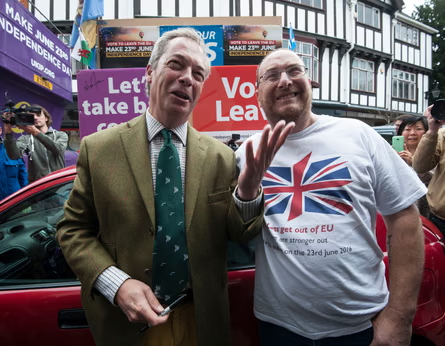
Well, Farage predates Reform. He came onto the scene probably about 15 to 20 years ago. He created a party called UKIP, which is the United Kingdom Independence Party, and they were a driving force and pushing for Britain to leave the European Union. They didn’t do well in British elections, but elections to the European Parliament, which they wanted to get out of, they did very well, and Farage was actually elected to the European Parliament. At that point he was still seen as a sort of fringe figure. He was often laughed at in the European Parliament because it was clear that he was there just to disrupt, but he had enough support on that one issue that he really put leaving the European Union on the agenda after the Brexit vote. Farage stuck with UKIP for two or three years before finally leaving because he apparently thought that they had gone too far to the right, which might surprise some people who assume that Farage

Reform UK Party
has himself on the far right. He left in 2018 and then founded Reform. Since then UKIP has become what a lot of people thought it was, which is a kind of fringe far right, if not outright Nazi Party, then on its way there. But that is becoming irrelevant, really, and reform is taken over. So UKIP back in 2015 I think UKIP got about 12 or 13% of the vote, but they only got one seat, and in the UK Parliament Reform now is on more than double what UK got back then. So if they hold on to that 30 ish percent in recent elections, 32 to 34% would get you pretty decent should get you a pretty decent majority, because the old two party system is broken down to the extent that a few, a few decades ago, you need 40, 45% to get a big majority. Now, I think, 34% as a really big majority. So could UKIP win the election with 30%.
As I mentioned before, the Conservatives have historically bad leadership, and I really don’t think that will last. There’s already talk about a leadership challenge in the Conservative Party. In fact, it’s never really gone away since the last leadership election, and Keir Starmer’s position is looking weak in the Labour Party as well. So it’s possible that he could face a challenge. I just don’t see both of those parties going into the 2029 election in the state that they’re in now, one of them, maybe, but both, I just don’t see it. So I think most likely see labour Reform head to head the in the in the 2029 election, it’s possible the Conservative Party could get their act together, in which case Reform would then have a challenge from both Labor to the left and the Conservatives on the same sort of
John Reimann
Trump supports Farage and Reform. Can you describe more about like what their politics are, and would Farag and Reform be roughly comparable to the policies of Trump over here?
Sean Cudden
It’s hard to tell, because they only really have one policy. They’re a one issue party, and that is immigration. They talk about other things from time to time. Farage is known to be skeptical when it comes to the NHS. He’s on a personal basis raised the possibility of a private insurance system to replace it, which should not go down well. It’s not as far as I’m aware Reform policy, but they don’t really seem to have in depth policies, and that’s another reason why I think 2029 is too far away for us to judge whether Reform will win or not, because they’ve never really come under any real scrutiny from the media.
Farage is seen as a sort of character, and all the attention has been on Farage on a sort of personal level. Once you get closer to the election, I think even Britain’s media, it’s not great, but it’s there are rules around elections. They have to have a degree of scrutiny of policies. They have to have a degree of balance between political parties, and I think at that point, probably before then, but certainly by that point, there’ll be enough scrutiny of the policies that the NHS at least, will become an issue for them, a problem for them. But Farage is an opportunist. So, for example, I think it was at the start of this year, there’s a big iron foundry in the north of England, and it’s the last major one in England, and it was about to be closed down by its owners, and Farage called for it to be nationalized, which on the right, you don’t get people calling for nationalization on the right. So he read the mood. He wants the north of England. This foundry is in the north of England. It’s part of that working class heartland that Labour used to own and is now up for grabs. And I think Farage saw that as an opportunity to win some support. There his name is mentioned in a context that people weren’t used to – as a friend of the worker, that kind of thing. But he did push the Labour government to ban the sale of the foundry, and it hasn’t closed down yet. So it’s kind a partial victory for Farage, although he may have painted himself into a corner, with it, because people in that region at least, will expect certain things from him now that they wouldn’t have in the past.
John Reimann
As I understand it, Farage calls for an end to British support for Ukraine. And also, there’s been some scandals involved in that, with that guy Gill. I think it is. Also, Russia helped finance the Brexit campaign. So can you talk about that whole issue and how that injects itself into British politics, in particular with Farage and Reform?
Sean Cudden
I’m not sure about Reform policy. Again, Farage says a lot of things in a personal capacity, but sometimes it’s unclear if he’s talking as a person or as the leader of a party. But certainly he has made comments exhibiting some skepticism about Britain’s support for Ukraine and Gill I think was the leader of Reform in Wales, and has just been found guilty of receiving bribes [from Russia], and he’s looking at jail time, which would be good. But Farage himself has kind of stayed out of that. So far, he hasn’t been too badly affected by it. There’s a lot of support for Ukraine in Britain, but there are a lot of skeptics too. So far, I think Farage has been hedging his bets. At least Reform has hedged his bets by not being too anti or too pro Ukraine. To a large extent, they’ve sat on the fence, although, yes, Farage in a personal capacity, has made some remarks, I think about how much it’s costing, not not making Russia our enemy, that sort of thing. But again, it’s very difficult to tell with Reform, because they don’t really have well worked out agenda all they ever seem to want, want to talk about as immigration, because that’s where they get the support, really.
John Reimann
I read a little bit just recently about stuff that’s come out where Farage as a teenager, up until like, 18 years old or so, was making racist comments and anti semitic comments and so on. Really ugly stuff. He was saying Can you explain that a little bit, and also has that had an impact on his on his popularity?
Sean Cudden
It’s difficult to tell if it’s had an impact on his popularity yet, because these stories only really just came out. I think it was last week they got a lot of publicity. I’m not sure of the accusation,
 Farage as a young man was connected to the far right. There are pictures around that show him on Nazi marches. I can’t remember if it was the National Front in the ‘70s or the British National Party in the ‘80s, but he did spend a little bit of time in contact with those people. So that ties in with that. What he said at school ties in with that. But this actually goes back to what I said before, about never really came under scrutiny. Last week when the media had a go on this was really the first time I’d ever seen a kind of sustained questioning and it made him uncomfortable. I think the British media are kind of like hyenas. The moment they sense blood, they start to turn and that might be the moment. It might be too soon to say that. It’s possible. It could be the moment that they start to think, “okay, maybe we, maybe we’ve been nice enough to this guy. Maybe it’s time to give them a hard time”. They can turn quite rapidly; it’s a kind of pack mentality. With the British media, there are left wing newspapers and right wing newspapers, and they do have different agendas. They will often attack the same individual, but for different reasons. So once they turn on Farage, they will really turn on him, and it won’t just be the newspapers, it will be increased scrutiny from TV channels as well. What extent that matters in an age when social media is so powerful, I’m not sure, but it can certainly do damage. And it’s really the first time that he’s come under real scrutiny. Even though he’s been around for 15 or 20, years, I’ve never seen him undergo that kind of scrutiny. It seems to have dropped off now.
John Reimann
So let’s talk a little bit about the Green Party. Americans may not know that the British Greens are different from here, because for one thing, it’s actually a membership party in Britain, which it is not here. And as I understand it, if you belong to the Green Party, there’d be membership meetings you could go to, and that sort of thing, is that, right? So just with that understanding of the difference, talk a little bit about the Green Party. For one thing, as I understand it, they support Ukraine, which they do not here. But in general, talk a little bit about who, where their support comes from, what and what perspectives you see for the Green Party.
Sean Cudden
For a long time, the Green Party had minimal representation. In fact, they’ve still got very minimal representation in any elected bodies. There are one or two places in England, I think Brighton, where they do well. I don’t know what it is about that particular town, but they’ve had a quite strong support there for a very long time, and usually only got one or two MPs, and one of them is always from Brighton, and they’ve always got good representation on the council. Their support nationally is usually around about 4% or 5%. There was a leadership election just a few months ago, and since then, support has grown up to

New Green Party leader Zack Polanski. He may have more popular appeal.
something like 15% or 16% now nationally. The new leader Zach Polanski, has very much tapped into the kind of young left wing voters that might expect Labour to have got in the past, or Jeremy Corbyn’s group would get now. He’s been very successful in connecting with them in a really short space of time. So their support in the polls has tripled in the space of just two or three months. As I said earlier, I think there’s a potential for some of Labour’s middle class left vote go Green. They are opular at the moment among students too, whether they’ve got any big support among working class is a question. I think under Polanski, maybe that could change, because he is more interested in social issues. It wouldn’t surprise me if things like housing and minimum wage and things like that were on their agenda now, with him in charge. He’s quite pro Ukraine as well, I think the Greens have always been supportive of Ukraine, so I don’t think that’s a big change for them.
John Reimann
And then there’s this new party, which up until now, has been Your Party of Sultana and Corbyn. Can you talk about that? And also, just to make it clear for people, as I understand it, both Corbyn and Sultana have called for an end to British support for Ukraine.
Sean Cudden
I’m not sure about Corbyn. Sultana has quite vocally.
“Your Party” as it’s still called was supposed to be the working title until they voted on a name. But I think today or yesterday, they voted at conference to actually confirm that it’s going to be called Your Party.

“Your Party” conference. “A bit of a shambles”, plus their leaders apologize for Putin.
Their conference has been a shambles – extremely acrimonious. A lot of far left activists were kicked out, and there seems to be a kind of a split already, which is really fast. I mean, the left is good at splits, but your Party seems to seem to have split before they even. Have been officially founded. It was Sultana who announced that Your Party was going to be a thing a few months ago, and immediately Jeremy Corbyn said, “Well, we haven’t formed a party. We’re in talks to form a party.” So even announcing that they were going to have a party led to an argument between Sultana and Corbyn, and it hasn’t gotten much better. Positive thing about Sultana, I definitely disagree with her on Ukraine, but the positive from her is that she thinks the party should be very much membership led. There seems to be another group in the party against that, and they think there should be a leader or some sort of strong, centralized leadership. I don’t know if that’s Corbyn at all, because Corbyn, when he was a leader of the Labour Party, was very much in tune with the membership, and wanted the membership to direct things. Now to some extent, for a party that has only just been formed, it already has a very powerful bureaucracy, which is really surprising. It’s a powerful bureaucracy in terms of planning, but it seems to be a really inept bureaucracy as well, and in every other sense. So I wouldn’t go so far as to say it’s still-born, but it doesn’t look good for that party. And as I said about Zach Polanski, he has moved the Greens, into the territory that you would expect Your Party to own – young voters, far left, very socially aware. So there’s not enough room for both the Greens and Your Party. I don’t know if Polanski was just trying to get under their skin, but he even publicly extended an invitation to Zara Sultana to join the Green Party. So I just think that that way things are. I see that battle going in favor of the Greens, and I just worry that Your Oarty is just not going to go anywhere.
John Reimann
What’s stopping them from joining the greens in the form of a merger, or just join. For example, Sultana is now an independent MP, why can’t she just switch over to the Greens? And same thing with Corbyn though he’s not in office.
Sean Cudden
I think when they started Your Party, the old leadership of the Greens was still there, and they saw themselves as more a sort of attempt to recreate Labour as it should have been. I hope that perhaps they could connect with the wider labour movement. But the Greens have a kind of upper middle class image. I don’t think it’s really fair anymore. I think that’s been changing, but that’s the image they have. So I’m not entirely sure why they didn’t just join the Greens in the first place, but maybe if Zach Polanski had been in the leadership role at the point that they were being pushed out of the Labour Party, maybe they would have gone to the Greens, but for whatever reason, they’ve elected to find their own party. And it does not look good.
John Reimann
In my view, the role of Putin internationally is huge. Now he’s got Trump as an ally actually, iand so it seems to me that Corbyn has taken that line about NATO is the fault of Russia invading Ukraine, and I’m pretty sure he has commented against British aid to Ukraine, as has Sultana. I think that’s really important, as far as the founding of Your Party, or whatever it’s to be called, as opposed to the Greens, which does support Ukraine. What are your thoughts on that?
Sean Cudden
Maybe that’s a reason why these two groups can’t just be merged into one. Maybe, Ukraine is one of the reasons for that. It’d be great to have Corbyn on our side, because he does have a very positive image on the far left, even though he’s not really on the far left; he’s a sort of old school, traditional center left kind of politician, but he’s very popular on the left broadly. There was a lot of hope for Sultana early on in her career. It’s very disappointing to hear her saying the things that she’s been saying about Ukraine. It unfortunately does resonate with a lot of people on the left in the UK, certainly those who are involved in the kind of more traditional party structures, groups like the Socialist Workers Party and various others on the left have been very, very much opposed to giving Ukraine support, whereas a lot of more independent socialists and quite a lot of anarchists have been very pro Ukraine. I don’t know yet how Your Party will see the Ukraine situation if Zara Sultana gets her way. And it’s it’s very much a membership based organization where the members set the agenda. Who knows what could happen? But if it’s down to Sultana and Corbyn to set the agenda, as far as Ukraine is concerned, that would be bad news.
John Reimann
Let’s talk about Scotland and the movement for Scottish independence. Where is that at now?

Support for Scottish independence is up.
Sean Cudden
In the most recent poll, it was about 11% undecided, and I think it’s about 45% yes, so yes is ahead of No, but there would need to be 50 plus if you need to be over 50% to get independence in a referendum. There’s no sign that there will be a referendum anytime soon, but for yes to be ahead of no is significant, because no won the last referendum by about 10% so I think independence has dropped down the agenda quite a lot. The Scottish National Party have had a lot of problems internally and changes in leadership, and they have really kind of taken their focus off of independence for a while. And lots of other things have been happening that have meant that in broader British context, Scottish independence hasn’t really been discussed that much, but yeah, yes, it’s nudged into the lead, so maybe it will start to come back onto The agenda.
John Reimann
What’s your view of the whole question?
Sean Cudden
I voted yes last time, and I would probably vote yes next time. It’s a strange issue, because it splits everybody. It’s not like a class thing. I guess probably Scottish Catholics are probably more pro independence than Scottish Protestants. But even then, it’s split. There doesn’t seem to be your particular group. You can see definitely working class people vote for it, middle class will vote against or whatever. It just seems to split everybody down the middle of the group. Except for the there is a right wing fringe in some working class Scottish Protestant communities that is very much pro Britain. But other than that, it’s it’s kind of every constituency is there to be won.
John Reimann
On the question of Ukraine, where do they fall on on that?
Sean Cudden
I don’t know if any polling has been done, but my impression is that Scotland in general, is quite pro Ukraine. The Scottish National Party (SNP) is certainly pro Ukraine. I don’t think there’s any real representation of the Scottish Parliament for the negative view. There’s one Reform in the Scottish Parliament, which I guess would probably be the one vote for Russia. The Scottish Green Party are very much supportive of Ukraine as are the Liberal Democrats and Labour and I think the Conservatives as well. So basically every party in there, apart from that one individual Reform person, is pro-Ukraine. There are a handful of independents. I don’t know which way they go, but yeah, the Scottish Parliament is certainly supportive. So if there any reflection on Scottish public opinion, then Scotland’s quite supportive too.
John Reimann
The reason I keep asking about that is, to me, it’s kind of a barometer of to what extent Putin is having an influence, and also Trump, And so my other question is in Scotland and in the rest of Britain, how is Trump seen ?
Sean Cudden
He certainly has supporters in Scotland. I don’t think there’s any polling on this, but my impression is that Trump is not well liked in Scotland, certainly when he visits, which he does with alarming regularity, he’s always met with protests. I don’t think he’s very well received in Scotland. I think there’s a fairly decent sized minority in England quite like him. I Think in Scotland, it’s a much smaller minority in terms of his influence in the Ukraine thing, as I said, every major party is solidly pro Ukraine, some of them, certainly the Conservative Party. There are some individuals who are fairly openly making a more skeptical, or not quite pro Russian, but more of the view whenever something happens, like the recent corruption scandal in Ukraine, the usual, the usual suspects sort of jump on bandwagon and say, “Oh, should we really be spending all this money? Should we be doing this?” They’ll always couch it like that.” And of course, need to support Ukraine, but all this corruption…” Sort of these words,
John Reimann
“We need to support them, but not that much.”
Sean Cudden
yeah. It’s really is a way for them to start to decrease the support. Because whenever the support comes down to try and push it further and further down, the Conservative Party itself, soon as they as soon as it happened, they were pro Ukraine, and they’ve actually remained pro Ukraine, which has surprised me. So Putin and Trump might be having an effect on on the British population, I don’t know. But in terms of Britain’s political parties across the spectrum, support for Ukraine, with the possible exception of Reform.
John Reimann
In conclusion: here in the United States, in my view, thre has been a huge vacuum that’s developed, and it’s been decades in the making, and a lot of it has to do with the massive confusion in the working class, and what I would call a crisis, a political crisis in the working class, not so much because of the weakening of the unions, although that too. That’s not so much what I’m referring to, but the consciousness and the degree of organization. Would you say that there’s something comparable to that in Britain, both, in Scotland and also in Britain as a whole? Also do you have any further summary comments you’d like to make?
Sean Cudden
In the UK, the working class left is very much connected to the post war consensus that created the welfare state, the NHS and so on. So its identity was very much around these things – unions, NHS. Basically a kind of the whole sense of class solidarity was built around that. It wasn’t radical, it wasn’t revolutionary, it was a pretty solid kind of solidarity. I think that has survived a little bit better in Scotland than it has in England, and maybe also survived better in Wales. Oddly enough, I think that’s because of the different national identities that they have. So in a weird kind of way, a sort of quiet Scottish nationalism and a quiet Welsh nationalism have helped to maintain a degree of class solidarity you don’t really see so much in England anymore. I don’t think the class solidarity in Scotland and Wales has remained the same, though. I think it’s weak. I do think it’s maybe slightly stronger than it is in England. I’m not so sure about Wales, but Scottish politics has always, at least in my life, has always been the opposite of whatever’s happening in England. So if the Conservatives are doing very well in England, badly in Scotland, if Labour are doing very well in England, start to lose support in Scotland. So Scotland was huge bastion of Labour support in the 1980s when the Conservatives were in power in England. And as soon as Labour got in in ’97 Scotland started to shift to the SNP, so Scotland’s always sort of had its marches to the beat of its own drum. Really, its politics tend to be based on, yes, this sort of remnant of class solidarity, but also the suspicion that whoever’s in government in London really doesn’t care very much for Scotland.
John Reimann
Are there any further comments, you’d like American workers and socialists to know and think about?
Sean Cudden
The working class in Scotland and Britain is still alive and kicking, and hopefully we can all push back against the demagogues that seem to be popping up over the world now.
Coming next: Sacha Ismail on the coming British budget crisis, support for Ukraine in Britain, and more

Sean Cudden
Discover more from Oakland Socialist
Subscribe to get the latest posts sent to your email.
Categories: Europe, politics, Uncategorized